
R&DE Stanford Food Institute

Foodservice
The Stanford Food Institute was created by Stanford University's Residential & Dining Enterprises to advance research, education, policy, business, and practice to promote a holistic approach to improving what people eat, how people access food, and the role that food plays in our lives. SFI has committed to cutting both pre- and post-consumer food waste through a data-driven strategy that links climate-smart dining with student and staff engagement. The Food Waste Prevention Playbook guides this work and sets a clear roadmap, from source-reduction to last-resort diversion, aligning with the U.S. goal to halve wasted food by 2030.
Food Waste Reduction Strategies
In practice, the Food Waste Prevention Playbook comes to life through four main strategies for operationalizing best practices:
Forecast and Order Accurately: Source reduction—lowering the total amount of surplus food generated in the first place—is by far the most preferred pathway for impact. To reduce food waste at the source, they focus on utilizing food waste data in order to forecast and order accurately.
Portion Control/Just-in-Time Cooking: Leveraging the best choice architecture research, they aim to create a dining environment that encourages students to take appropriate portions in order to reduce post-consumer food waste. In addition, just-in-time preparation helps ensure that they make the amount of food that is needed to feed students as they arrive, allowing them to flex production depending on how busy the dining halls are. This strategy has the dual benefit of providing students with the freshest food possible while minimizing overproduction and wasted food on the serving line.
Repurpose Leftovers: SDHA’s Repurpose with a Purpose is rooted in a campus-wide culture of sustainability. Culinary teams repurpose high-quality ingredients, like animal-based proteins, broccoli stems, bread ends, and herb trimmings, into cost-effective, flavorful dishes that reduce food waste and support environmental goals. As part of their broader commitment, SDHA also participated in the MCURC Repurpose with a Purpose study, contributing recipes and impact data that aligned with their in-house strategies.
Donate: They work with local food recovery organizations and their culinary team to coordinate food donations to those in need. For every special event they host, they assign a chef to oversee ordering, train chefs on processes and metrics for food waste reduction, understanding what data will be captured, and being the liaison for food donations.
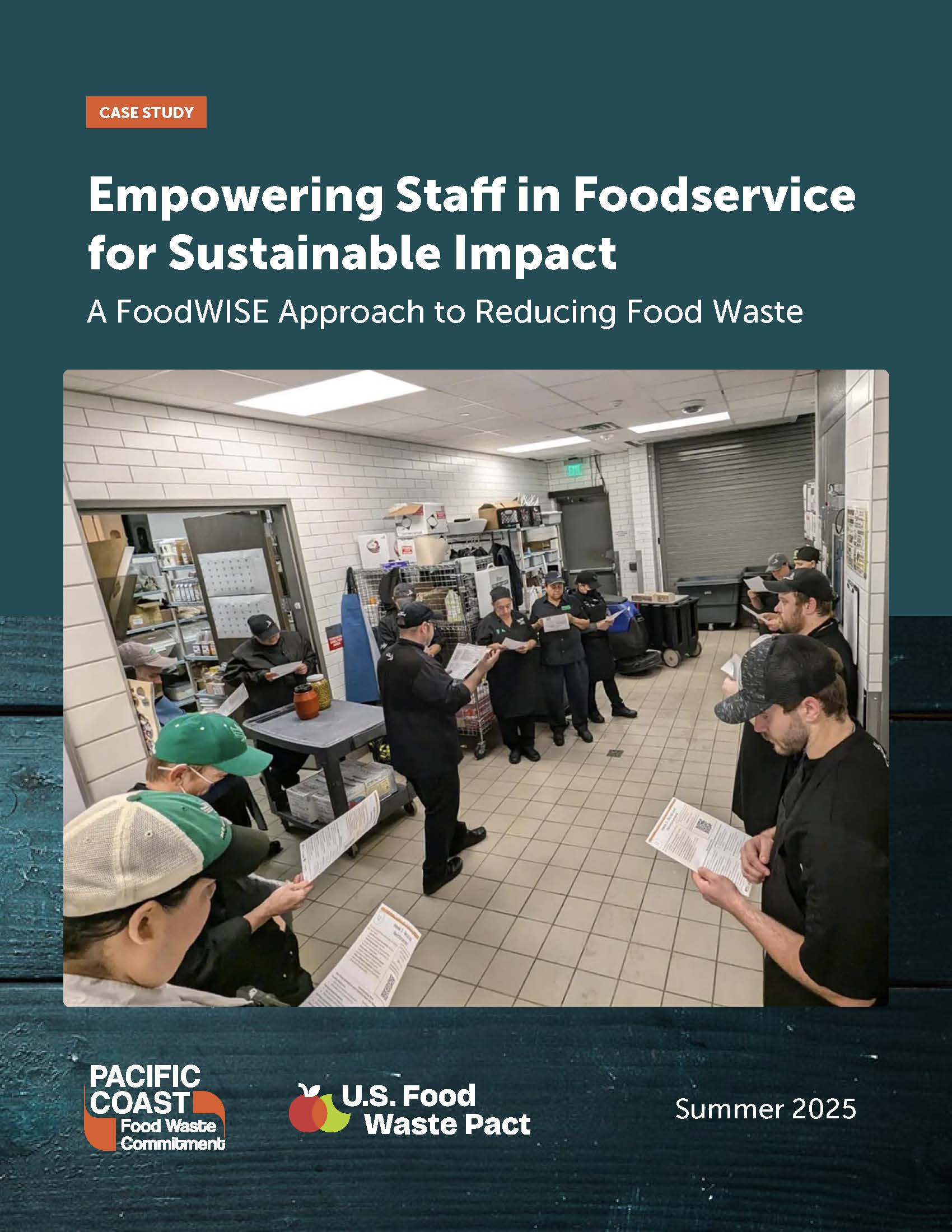
Case Study
Empowering Staff in Foodservice for Sustainable Impact
June 20, 2025
In this case study, the R&DE Stanford Food Institute, with support from Aramark, the Menus of Change University Research Collaborative, and Sodexo, piloted employee engagement projects in 10 different corporate and collegiate kitchens across the country, generating over 100 food waste reduction ideas and building sustainable cultures through frontline worker engagement.